Home Products About Projects Contact Login Request a Demo

Real-Time Drilling & Well Control Simulation

Four simulators, one engine. Pressure, hydraulics, fluid column, and formation response are computed from first principles — not looked up, not scripted. The bottom-hole pressure model is mode-specific: hydrostatic plus surface pressure when static, hydrostatic plus annular friction plus back-pressure when circulating, hydrostatic plus surge when tripping in, hydrostatic minus swab when tripping out. Gas segments expand per the Real Gas Law (PV = ZnRT), so a kick migrating up the annulus behaves the way it does on a real well, not the way a scripted trigger fires.

IWCF Accredited

Drilling Simulator

An IWCF accredited drilling and well control simulator — delivered as software, built on a first-principles physics engine, and priced for the training centers, universities, and mid-market operators of Southeast Asia and the Middle East.

Physics Engine. Bottom hole pressure, standpipe pressure, casing pressure, hydraulic losses, and formation response are computed from first principles — not lookup tables, not simplified approximations. Because BHP is physically different under different operating regimes, the engine switches models automatically: static shut-in is hydrostatic plus surface pressure; circulating is hydrostatic plus annular friction pressure plus surface back-pressure (for MPD); tripping in is hydrostatic plus surge; tripping out is hydrostatic minus swab. Four API RP 13D 7th Edition rheology models — Newtonian, Bingham Plastic, Power Law, and Herschel-Bulkley — drive dedicated pressure-loss sub-calculators for surface lines, drill string, bit nozzle, annulus, and choke line. Designed by our team of petroleum engineers, the simulator is accredited by IWCF for well control training.

Fluid Column. The annulus is modeled as discrete fluid segments — original mud, kill mud, gas, oil, water — each contributing stratified hydrostatic pressure. Gas segments expand per the Real Gas Law (PV = ZnRT), so a migrating kick accelerates near surface the way real gas does, and a swabbed influx during tripping triggers well-control responses from the physics itself — not from a scripted event.

Instructor Station. The instructor station provides complete control over the training exercise: configure rig equipment, well geometry, directional surveys, and formation tables (pressure gradient, drillability, temperature, activity, fluid type, and permeability per layer). During live simulation, the instructor injects any of ten well control failure modes, monitors student decisions, and captures snapshots at key moments for post-exercise review — every decision trace auditable against the kill sheet.

Interface Screenshots

Hydra Instructor Station - BOP Stack Configuration with well control equipment settings
Instructor Station — Well Control Equipment

BOP stack configuration, mud gas separator, BOP control system, and choke manifold settings.

Hydra Instructor Station - Well Data Configuration with formation and geometry settings
Instructor Station — Well Configuration

Well data, reservoir data, fracture pressure, well survey, formation pressure, and well geometry tabs.

Hydra Instructor Station - Rig Configuration with equipment specifications
Instructor Station — Rig Configuration

Rig general info, hoisting system, circulating system, well control equipment, and rig equipment tabs.

01

Mode-Specific Real-Time Physics Engine

Pressure, hydraulics, and fluid dynamics update continuously via a SubsystemScheduler. BHP is computed regime by regime — static (hydrostatic + surface pressure), circulating (hydrostatic + AFP + SBP), tripping in (hydrostatic + surge), tripping out (hydrostatic − swab) — using published API reference formulas with verifiable constants.

02

API RP 13D 7th Edition Rheology

The four rheology models canonical in the 7th Edition (2023) of API RP 13D: Newtonian, Bingham Plastic, Power Law, and Herschel-Bulkley — the latter API-recommended as primary for hydraulics in complex wells since 2006. Each drives dedicated pressure-loss sub-calculators for surface lines, drill string, bit nozzle, annulus, and choke line.

03

Segment-Based Fluid Column

Discrete fluid segments tracked from surface to TD with stratified hydrostatic calculation. Gas segments expand per the Real Gas Law (PV = ZnRT) — not a Boyle’s Law approximation — so kick migration, gas-at-surface, and second-influx detection emerge from the physics, not from scripted triggers.

04

Complete Well Control Simulation

Automatic kick detection when hydrostatic < formation pressure. Supports Driller’s Method and Wait & Weight kill procedures. Real-time kill sheet: ICP, FCP, MAASP, kill weight, pressure schedule. Tracks SIDPP, SICP, pit gain, and shut-in states — all verifiable against a hand-calculated kill sheet.

05

10 Injectable Well Control Problems

All 10 IWCF-required problem categories: Nozzle Plugged, Nozzle Washout, Choke Plugging, Choke Washout, Choke Leak, Surface Line Leak, Pump Failure, BOP Fails to Close, BOP Leak, BOP Actuator Failure. Configurable severity (0.0–1.0), progressive onset, and three trigger modes.

06

Managed Pressure Drilling (MPD)

Integrated CBHP and PMCD modes with PID-based automatic choke controller, pressure-window monitoring (pore/frac window), RCD physics model, connection-sequence automation, back-pressure pump simulation, and flow-balance monitoring — the full MPD workflow in one simulator, no separate license.

07

Subsea Well Control

Activates automatically when the well is configured as offshore/deepwater. Choke-line friction loss, riser gas expansion tracking, MUX control pod management (Yellow/Blue with failover), depth-adjusted accumulator calculations, LMRP disconnect simulation, and autoshear/deadman emergency systems.

08

Three Unit Systems, 40+ Categories

API Field (psi, ft, ppg, bbl, GPM), SI (kPa, m, kg/m³, m³, L/min), and Metric (bar, m, SG, L, L/min) — switch per session across 40+ physical-quantity categories so crews train in the units they use on the rig floor, whether the program prep is IWCF Arabic, Bahasa, or English.

Deployment Configurations

Configuration Description Use Case
Desktop Trainer Single PC running instructor and driller screens. Minimum 1280×800 resolution. Individual study, small-group instruction
Dual-Screen Station Instructor on one display, driller console on a second display or separate computer. Standard classroom instruction
Web-Based Multi-Station Instructor runs the web server; each student connects via browser. One engine per browser session. Scalable classroom deployment, 10–20+ simultaneous students
Full-Scale Console Physical BOP panel, choke console, and pump controls connected to the software engine via HardwareManager. High-fidelity training centers

Drilling Well Control Simulator

IWCF Accredited

An IWCF accredited well control certification package built on the same first-principles engine that powers the full Drilling Simulator.

Runs the well control module of the Hydra engine: automatic kick detection when hydrostatic drops below formation pressure, Driller’s Method and Wait & Weight kill procedures, and a live kill sheet tracking ICP, FCP, MAASP, kill weight, SIDPP, SICP, and pit gain. Instructors inject any of 10 IWCF-aligned problem categories at configurable severity and trigger timing, then monitor student responses from a dedicated instructor station.

Key Capabilities

  • 10 injectable problems — Nozzle Plugged/Washout, Choke Plugging/Washout/Leak, Surface Line Leak, Pump Failure, BOP Fails-to-Close, BOP Leak, BOP Actuator Failure
  • Driller’s Method and Wait & Weight kill procedures with live pressure schedule
  • Subsea option: MUX Yellow/Blue control pods with failover, autoshear/deadman, LMRP disconnect, choke-line friction, and riser gas expansion tracking
  • Kill sheet calculator (ICP, FCP, MAASP, kill mud weight) that updates as the well state evolves
  • Instructor problem-injection with severity (0.0–1.0), progressive onset, and three trigger modes

Who It’s For

  • Training centers preparing IWCF Level 2–4 well control candidates
  • Operator and drilling contractor competency assurance programs
  • Universities and technical institutes teaching well control fundamentals

Intervention Simulator

IWCF-Aligned Training

Rigless well intervention trainer with a dedicated physics engine — architecturally separate from the drilling simulator.

A standalone intervention module built around its own parameter manager, state manager, and console. Covers wireline operations with Slickline, Braided Line, and E-Line unit configurations. PCE components (stuffing box, stripper, strip rams) are modelled as continuous seal physics so surface pressure, string weight, and seal behaviour respond dynamically to operations rather than scripted events. Coiled Tubing support is on the module roadmap.

Key Capabilities

  • Wireline operations: Slickline, Braided Line, and E-Line unit types
  • Core operations: set plug, retrieve plug, drift run, inflow test, DHSV operation, sliding sleeve
  • PCE continuous seal physics for stuffing box, stripper, and strip rams
  • Dedicated intervention console: well schematic, pressure gauges, barrier status, alarm panel, event log, PCE controls
  • Instructor-defined tool availability with student tool assembly and system evaluation

Who It’s For

  • IWCF well intervention certification candidates
  • Wireline service companies developing operator competency
  • Operators running intervention competency assurance programs

MPD Simulator

Professional Training

Managed Pressure Drilling training package with PID choke automation and real RCD physics.

Focused Managed Pressure Drilling configuration of the Hydra engine. Simulates Constant Bottom Hole Pressure (CBHP) and Pressurized Mud Cap Drilling (PMCD) modes with a rotating control device model, automatic PID-based choke controller, and back-pressure pump. BHP is calculated as annulus hydrostatic + AFP + casing pressure + surge − swab + surface back pressure, so the pressure window stays visible throughout connections, kicks, and pump starts/stops.

Key Capabilities

  • CBHP and PMCD operating modes
  • Rotating Control Device (RCD) physics model
  • PID-based automatic choke controller with manual override
  • Pore-fracture pressure window monitoring with live margin display
  • Back-pressure pump simulation and flow balance monitoring
  • Connection-sequence automation for pump-stop pressure management

Who It’s For

  • MPD crews and choke operators on HPHT or narrow-margin programs
  • Drilling contractors deploying MPD equipment on new rigs
  • Training providers delivering MPD-specific courses
One Engine. Six Configurations.

Every Hydra tier runs the identical real-time physics engine — 13 subsystems, 7 kill methods, 16+ well-control scenarios. Choose the configuration that fits today’s training room and budget, then upgrade in place: snapshots, rig configurations, and exercises carry across the entire range.

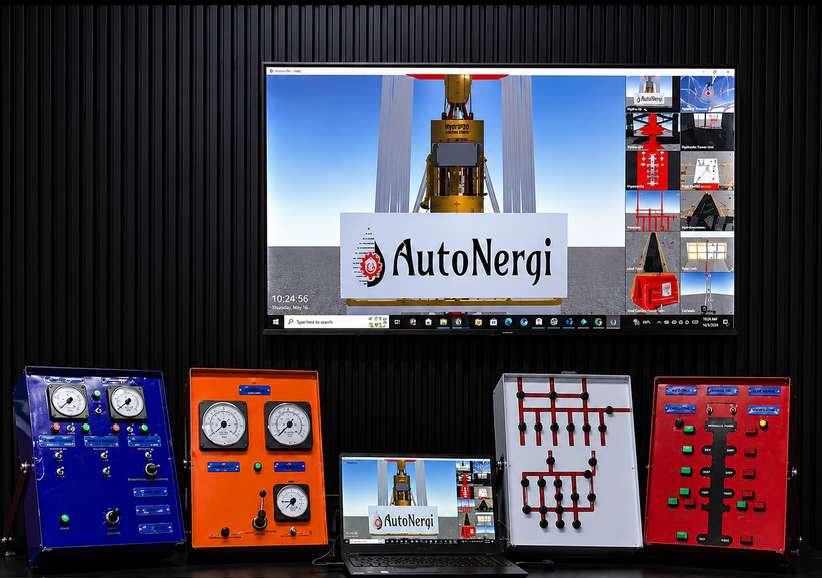
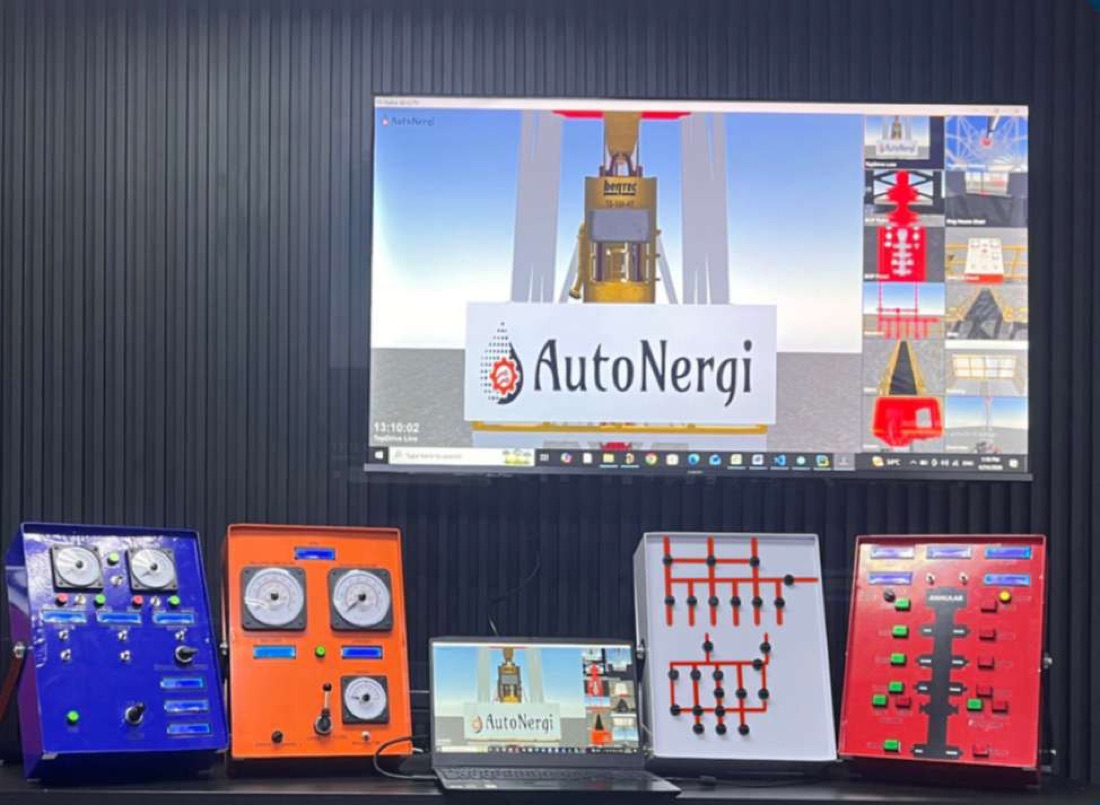
The full Hydra panel line-up — blue Driller Panel, orange Remote Choke Panel, manifold and red BOP control panels arranged in front of the 3D rig view on a wall display Live installation
One engine · every panel real hardware
Live engine telemetry
Standpipe pressure computed from first principles, not scripted.
Standpipe Pressure · psi
SPP · psi
Casing · psi
Pump · spm
40–60%
Lower cost than comparable global market leaders
436+
Prospects worldwide · MENA & SE-Asia focus
13 · 7 · 16+
Subsystems · kill methods · scenarios
IWCF
Accredited training on every tier
Browser-Based · Multi-User Web Simulator
HYDRA-Web

Drilling-simulator training with no install and no shipping, from any browser — the same physics engine as every Hydra SKU, delivered as a multi-user web service.

Best for
Distributed cohorts & remote delivery
Request Technical Specs → Book a Demo
The Hydra browser simulator — the Driller Console showing real-time parameters, live rig visualization, control panel and Swaco well-control panel rendered in the browser Software
HYDRA-Web · in-browser simulator UI
0 install
Runs in-browser
3
Live session roles
100+
Concurrent engines
7
Kill methods
What makes it different
01
Zero install — any browser

Trainees open a URL. No agents, plugins, admin rights or firewall exceptions — onboarding a new cohort takes minutes.

02
Multi-user shared sessions

The instructor shares a session URL; driller and supervisor join the same live exercise while the instructor keeps pause, freeze and injection control.

03
Survives reconnects

A browser refresh or network drop doesn’t stop the exercise — the engine keeps running server-side and trainees rejoin where they left off.

04
Scales horizontally

Each engine is a server-side process. A single mid-tier node hosts 100+ concurrent engines; scale-out is simply more nodes behind a load balancer.

System requirements
ClientPer user
BrowserChrome 120+ / Edge / Firefox
CPUCore i3 / Apple M1 / ARM
RAM8 GB
GPUIntegrated sufficient
Display1 × 1080p
Network10 Mbps · <80 ms to host
ServerHost
OSUbuntu 22.04 LTS
CPU16 vCPU (Xeon Gold / EPYC)
RAM64 GB
Storage1 TB NVMe + object store
Network10 Gbps · LB sticky sessions
Capacity100+ engines / node
Software-Only · Three-Screen Classroom
HYDRA-10

The full Hydra engine on a standard training-room workstation — instructor, driller and choke stations on screen, every control on-screen. The software foundation the hardware tiers build on.

Best for
Classroom theory & procedure labs
Request Technical Specs → Book a Demo
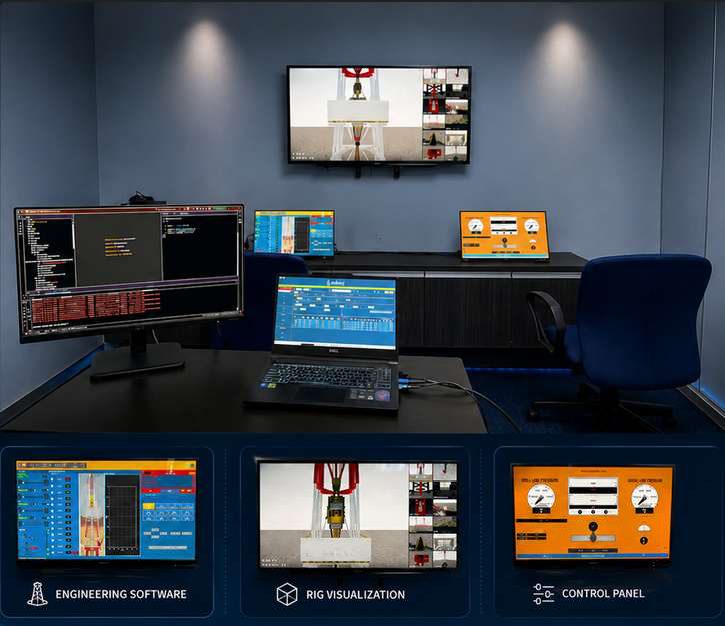
A Hydra-10 desktop install — a dual-monitor workstation and laptop running the simulator's engineering software and an orange control-panel view, with a wall-mounted 3D rig display and engineering-software, rig-visualization and control-panel callouts below Classroom
Desktop install · engineering, rig view & controls
3
On-screen stations
13
Engine subsystems
7
Kill methods
16+
Scenarios
What makes it different
01
Pure software, fast rollout

No panels to wire — install on existing classroom PCs and run the identical engine that drives every hardware tier.

02
Three on-screen stations

Instructor, driller console and remote choke each on their own screen, so a class works the full well-control loop without hardware.

03
Same engine, same curriculum

13 subsystems, 7 kill methods and 16+ scenarios — the on-screen controls are the only difference from the hardware SKUs.

04
Upgrade in place

Add hardware panels (Hydra-20/30/40) or a cyber chair (Hydra-90) later; snapshots, rigs and exercises carry straight over.

System requirements
WorkstationSoftware-only
OSWindows 10 / 11 64-bit
EngineIdentical to every Hydra tier
Display3 × 1080p monitors
HardwareNo panels — fully on-screen
Network1 Gbps LAN
Full specContact for the spec sheet
Entry Hardware Tier · 2 Panels · 2 Screens
HYDRA-20

A Driller-and-Remote-Choke panel package — two screens plus two real hardware panels with real potentiometers, switches and PWM gauges, on the same engine as the flagship.

Best for
Entry hardware feel & paired drills
Request Technical Specs → Book a Demo
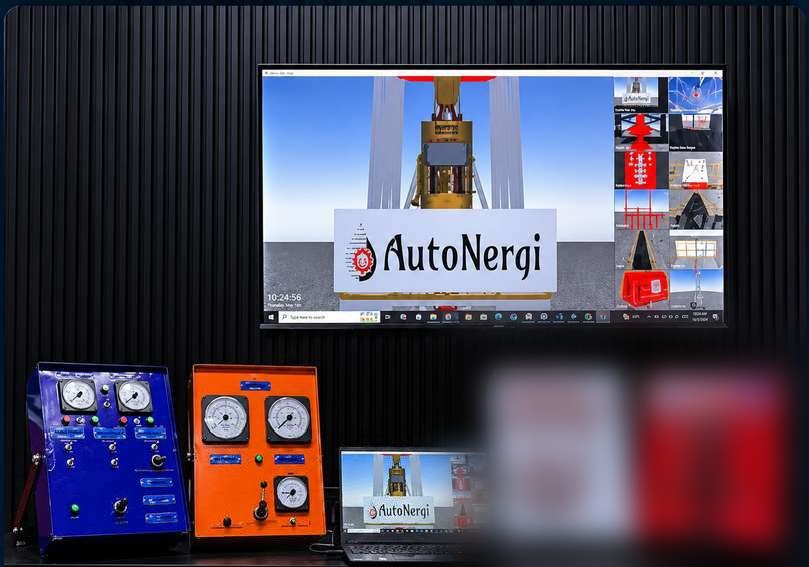
A Hydra-20 portable setup — a large 3D rig-visualization screen above a bench of blue, orange, white and red well-control and choke panels with a laptop running the simulator Live install
Portable hardware · control panels with live rig view
2
Hardware panels
2
Screens
7
Kill methods
16+
Scenarios
What makes it different
01
Real controls, real muscle memory

Trainees grip continuous pump knobs, flip switches and watch analog needles move — the simulator drives PWM voltages to the gauges in real time, the same feedback loop a real driller has in a real cabin.

02
Two panels, two roles

A Driller Panel (pumps, slips, return-flow alerting) and a Remote Choke Panel (choke selection, hydraulic regulator, live position gauges) let two trainees pair up.

03
Engine-identical to higher SKUs

The same physics, problem injection and kill-method suite as Hydra-30/40/90 — the only difference is which controls are physical versus on-screen.

04
Quick to deploy

Two USB-serial panels plug into the workstation and the simulator auto-detects them at startup — no structural changes to your training room.

System requirements
WorkstationMinimum
CPUCore i5 11th / Ryzen 5 5600
RAM16 GB DDR4
GPUGTX 1660 6 GB
Storage512 GB NVMe SSD
Display2 × 1080p
Network1 Gbps LAN
WorkstationRecommended
CPUCore i7 12th / Ryzen 7 5800X
RAM32 GB DDR4
GPURTX 3060 8 GB
Storage1 TB NVMe SSD
Display2 × 1440p
Network1 Gbps · same subnet
IWCF-Grade Well-Control · Three-Panel Trainer
HYDRA-30

IWCF-grade well-control training in a single pod — Driller, Remote Choke and a real five-slot BOP Control Panel, driven by the same real-time engine as every Hydra SKU.

Best for
IWCF well-control certification prep
Request Technical Specs → Book a Demo
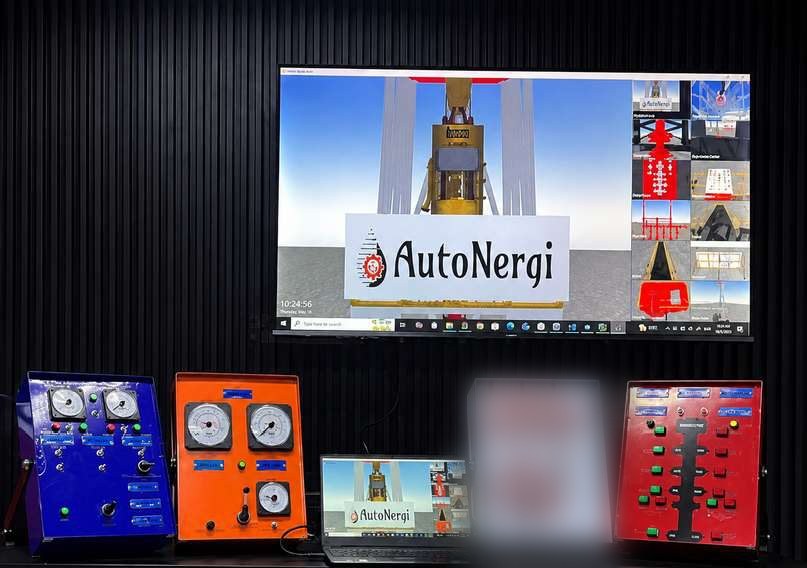
A Hydra-30 setup — a 3D rig-visualization screen over a bench of blue, orange, white and red control panels with a laptop running the simulator Live install
Mid-range console · multi-panel set with live rig view
3
Hardware panels
5
Slot BOP stack
7
Kill methods
L2
IWCF surface BOP
What makes it different
01
Real five-slot BOP stack

The BOP panel matches the simulator’s expected stack — Annular, two ram slots, Spool and a ram slot — so trainees rehearse against a real-rig stack composition.

02
Realistic BOP failure exercises

Inject actuator failures, fails-to-close and leaks; the engine drives faults through the same physics as normal operation and the travelling indicators reflect the real fault.

03
Hardware-compatible validation

Recognised by the rig-configuration UI as a hardware install, unlocking BOP-stack validation that confirms your panel matches the configured rig.

04
Built for standard curricula

Aligned with IWCF Level 2 (Surface BOP) and driller-level well control standards — every kick-detection, shut-in, Driller’s Method and Wait-and-Weight exercise runs end-to-end.

System requirements
WorkstationMinimum
CPUCore i7 11th / Ryzen 5 5600X
RAM16 GB DDR4
GPURTX 3050 8 GB
Storage512 GB NVMe SSD
Display2 × 1080p
Network1 Gbps · USB hub
WorkstationRecommended
CPUCore i7 13th / Ryzen 7 7700X
RAM32 GB DDR5
GPURTX 3060 / 4060 8 GB
Storage1 TB NVMe SSD
Display2 × 1440p
Network1 Gbps · UPS
Top of the Surface-Only Line · 4 Panels · 2 Screens
HYDRA-40

A full surface-stack simulator — Driller, Remote Choke, BOP and a 30-valve Manifold panel. Every surface valve in your trainee’s hand, short of a cyber-chair installation.

Best for
Operator-grade surface-equipment training
Request Technical Specs → Book a Demo
A Hydra-40 full-featured system — a large 3D rig-visualization screen above a full bench of blue, orange, white and red well-control and choke panels with an operator laptop Live install
Full-featured bench · complete control-panel set
4
Hardware panels
30
Valve toggles
5
BOP stack slots
7
Kill methods
What makes it different
01
Real standpipe & choke manifolds

30 GPIO-driven valve toggles span the standpipe manifold, choke manifold and mud-gas-separator routing — trainees physically open and close valves the way they will on the rig floor.

02
Complete surface stack

Every critical control loop has a tactile surface: pump SPM, choke selection, BOP actuation, manifold routing. The 3D rig view and alerts stay on-screen; the controls are real.

03
MGS routing exercised live

Mud-gas-separator routing is a real-world failure point — Hydra-40 makes the trainee physically route returns to or around the MGS during well-control exercises.

04
Operator-grade without the cyber chair

Full surface-equipment realism in a modest footprint, instructor-led from a single workstation — the drilling-contractor sweet spot.

System requirements
WorkstationMinimum
CPUCore i7 12th / Ryzen 7 5800X
RAM32 GB DDR4
GPURTX 3060 8 GB
Storage1 TB NVMe SSD
Display2 × 1080p
Network1 Gbps · 7-port hub
WorkstationRecommended
CPUCore i9 13th / Ryzen 9 7900X
RAM64 GB DDR5
GPURTX 4070 12 GB
Storage2 TB NVMe + 2 TB HDD
Display2 × 1440p
Network1 / 2.5 Gbps · UPS
Cyber-Chair Flagship · Full-Immersion Trainer
HYDRA-90

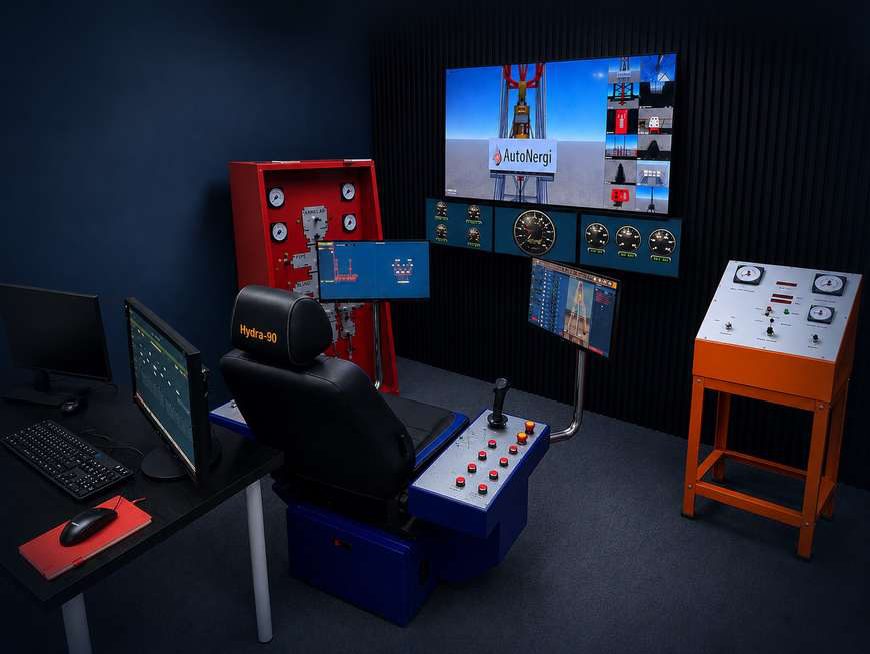
A real driller’s cabin, built into your training centre — seven synced screens, a dual-joystick cyber chair and per-pump SPM control, running the same real-time engine as every Hydra SKU.

Best for
Supervisor-grade, full-immersion centres
Request Technical Specs → Book a Demo
The Hydra-90 full-mission simulator room — a driller's joystick chair labelled Hydra-90 facing a wall of synced screens with gauge banks, a red BOP control panel and an orange choke console Flagship
Hydra-90 cyber chair · full-mission rig-floor cockpit
7×
Synced screens
2×
Joystick controls
7
Kill methods
L4
IWCF supervisor
What makes it different
01
Seven-screen immersive layout

Instructor, Driller Console, Martin-Decker, Manifold, two gauge banks and a dedicated 3D rig view — each on its own monitor, all synced from one engine.

02
Cyber chair, real joysticks

Dual joysticks drive TDS positional control, camera, brake pressure and contextual buttons — trainees rehearse the exact sequence used at a live cyber-chair cabin.

03
Per-pump SPM step controls

A dedicated SPM board with increment / decrement buttons for each pump lets trainees adjust strokes-per-minute the way they will in the field.

04
Supervisor-grade exercises

IWCF Level 3/4 supervisor-grade well control, complex MPD and deep-water subsea scenarios run end-to-end, with an optional Hydra_VR companion.

System requirements
WorkstationMinimum
CPUCore i9 12th / Ryzen 9 5950X
RAM64 GB DDR5
GPURTX 4070 12 GB
Storage2 TB NVMe SSD
Display7 × 1080p
Network1 Gbps · dedicated VLAN
WorkstationRecommended
CPUi9-14900K / Ryzen 9 7950X3D
RAM128 GB DDR5 ECC
GPURTX 4080 16 GB / A4500
Storage4 TB NVMe + 4 TB NAS
Display7 × 1440p + instructor
Network2.5 / 10 Gbps VLAN
Also available

Every hardware tier ships in an ELITE variant — panels 70% thinner with fully digital gauges. Made in the Middle East under Malaysian supervision, to world-class standards.

Coming Soon

Planned additions to the Hydra platform — all built on the same real-time engine and instructor station.

Stuck Pipe Simulator

Coming Soon

Scenario-based trainer for stuck pipe recognition, diagnosis, and recovery.

Planned simulator focused on developing crew response to stuck pipe events — one of the most costly non-productive time drivers in drilling operations. Will cover differential sticking, mechanical sticking (pack-off, key seating, undergauge hole), and wellbore instability, with a structured diagnosis workflow and recovery techniques that respond to the well’s real-time physics state.

Planned Scope

  • Differential sticking, pack-off, key seating, and wellbore-instability scenarios
  • Freeing techniques: spot pills, jarring sequences, circulation, back-off and washover
  • Decision-support workflow guiding trainees through diagnosis before action
  • Integrated with the same rig, well, and formation configuration as the Drilling Simulator

Daily Mud Report System (Mud Stations)

Coming Soon

Digital drilling fluid program management for mud engineers and rig-side mud stations.

Planned operations module for complete mud program oversight — replacing paper mud reports with structured digital entry, property trending, and automatic treatment calculations. Tracks chemical inventory and consumption, supports standard industry report formats, and keeps multi-well history accessible for post-well review.

Planned Scope

  • Structured digital entry of mud test data (rheology, density, filtration, solids, chlorides, pH)
  • Property trend visualization and automatic exception flags
  • Chemical inventory and consumption tracking with low-stock alerts
  • Treatment calculations (weight-up, dilution, additive dosing)
  • Multi-well support with PDF and Excel export in standard industry formats

Daily Drilling Report

Coming Soon

Paperless DDR with automatic KPI rollups, cost tracking, and depth-time plotting.

Planned operations module to replace paper daily drilling reports with structured crew-side entry, automatic KPI calculation, and enterprise export. Rolls up non-productive time, cost per foot, and depth-vs-time curves across a well, and tracks actual spend against AFE at the activity level. Role-based access separates field engineer, drilling supervisor, and management views.

Planned Scope

  • Structured crew-side entry with validation to catch data errors at source
  • Automatic KPI rollup: NPT, cost per foot, footage per day, connection times
  • Depth-vs-time curves with planned-vs-actual overlay
  • AFE tracking at activity level with variance flags
  • Role-based access for field engineer, supervisor, and management
  • PDF and Excel export for enterprise integration

Ready to See It in Action?

Schedule a live demonstration with our engineering team. We will walk through the physics engine, instructor station, and deployment configurations relevant to your training program.